
By Rebecca McAllister

On December 7, 2024, my mother was so disappointed that neither the media nor anyone else she had heard acknowledged the “National Pearl Harbor Remembrance Day.” At 8 years old, she remembers hearing Roosevelt’s speech on the radio when she was home from elementary school for lunch that Monday.

On Sunday, December 7, 1941, just before 0800, Japan launched a surprise attack on U.S. military bases at Pearl Harbor and the Philippines, subsequently declaring war on the United States and the British Empire.

While we often hear about the ships destroyed in the harbor on that day, attacks were made in numerous places across Oahu. In the first wave of attacks, the Japanese assigned numerous fighters and bombers to suppress airbases, with fighters igniting planes using their machine guns and cannon fire while bombers targeted them with high explosives.

The second wave also focused on airfield strikes. Wheeler Army Airfield, located in central Oahu, was the main fighter base in Hawaii. Nearly two-thirds of the 140 planes stationed there, primarily P-40 and P-36 fighter aircraft, were destroyed or unable to fly. A similar proportion of B-17, B-18, and A-20 bombers at Hickam Army Airfield—adjacent to the Pearl Harbor Navy Yard—were also destroyed or damaged enough to remain grounded. Many personnel were killed at Hickam when the Japanese bombed their barracks. In addition, smaller Bellows Field in eastern Oahu suffered damage, with several P-40s destroyed, including two whose pilots bravely attempted to take off during the enemy attack.

U.S. Navy and Marine Corps air stations on Ford Island in Pearl Harbor, Ewa to the west of Pearl, and Kaneohe Bay near Bellows Field were heavily targeted during the raid. Ewa, which predominantly housed carrier-type bombers and fighters, saw its count drop from nearly fifty planes to less than twenty. Ford Island and Kaneohe, home to several squadrons of long-range PBY patrol seaplanes, faced massive assaults, losing about half of their planes at Ford Island and almost all at Kaneohe.

The Museum of Flight features an entire wall dedicated to the bombing of Kaneohe Bay, showcasing before-and-after pictures of a PBY Catalina (a flying boat) taken mere hours before the attack, alongside images depicting the extensive damage inflicted. Some recovered PBY Catalina aircraft components and artifacts salvaged from the aftermath are displayed on the wall. Even more impactful are the images of the ceremony, parade, and internment of those killed.  It was a horrible day with tremendous historical significance, just 83 years ago.   More than 2,400 Americans died in the attack, including civilians, and another 1,000 people were wounded.

As George Santayana’s famous works from 1905 declare, “Those who cannot remember the past are condemned to repeat it.”

For those interested in more details, there is an excellent visual map archive at https://1941.mapping.jp/

References:

December 7, 2019 – WJK THD. https://wjkthd.com/2019/12/07/december-7-2019/

Pearl Harbor – October 29, 2009 – https://www.history.com/topics/world-war-ii/pearl-harbor

Attacks on Airfields and Aerial Combat – Naval History and Heritage Command – https://www.history.navy.mil/our-collections/photography/wars-and-events/world-war-ii/pearl-harbor-raid/attacks-on-airfields-and-aerial-combat.html
Wiki – https://en.wikipedia.org/wiki/Day_of_Infamy_speech

Wiki – https://en.wikipedia.org/wiki/Attack_on_Pearl_Harbor

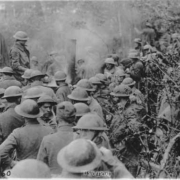
WWI soldiers with their helmets gathered around for a meeting or mail call

The 82nd Division, later known as the 82nd Airborne Division, has an incredible history that began during World War I. On August 5, 1917, the division was officially constituted into the National Army, part of the rapid expansion of U.S. military forces in response to America’s entry into the global conflict. A few weeks later, on August 25, 1917, the division was organized at Camp Gordon in Georgia, where it began to forge its identity as a unique and cohesive fighting force.

Naming the 82nd

Its diverse makeup set the 82nd Division apart from other military units. Unlike many divisions that drew primarily from local recruits, the 82nd welcomed conscripted soldiers from all 48 states in the Union (Alaska and Hawaii became states in 1959). The citizens of Atlanta held a contest to give a nickname to the new division, and in April 1918, Major General Eben Swift, the commanding general, chose “All American.”. To this day, the division’s shoulder patch proudly bears the letters “AA” as a reminder of its unique origins and the unity of its members from all across the nation.

82nd Training and Deployment

In 1918, the 82nd Division completed its training in the United States and prepared for deployment to the Western Front in Europe, where the Allies were locked in grueling trench warfare against Germany. The division was soon sent overseas, landing in France and joining the American Expeditionary Forces under General John J. Pershing. Though new to the battlefield, the soldiers of the 82nd quickly adapted to the harsh conditions of trench warfare and the fast-evolving tactics of the Great War.

The Meuse-Argonne Offensive: A Defining Moment

One of the 82nd Division’s most significant engagements during World War I was the Meuse-Argonne Offensive, a major Allied assault aimed at breaking through German defenses. This offensive, which began in September 1918, was the largest operation by American forces in the war and played a crucial role in hastening the end of the conflict.

The 82nd Division fought bravely in the Meuse-Argonne, displaying resilience and innovation under highly challenging conditions. The soldiers faced enemy fire and difficulties navigating through dense forests, muddy terrain, and heavily fortified German positions. Their efforts, alongside those of other American and Allied units, eventually led to the successful penetration of German lines. The division’s courage and effectiveness in battle earned it recognition and respect from its peers and commanders.

The Museum of Flight’s 82nd Division Uniform: A Piece of Living History

The legacy of the 82nd Division’s service in World War I lives on, not only in history books but also through preserved artifacts like the uniform worn by Private T.L. Wagner, a division member during the Great War. This uniform, now housed at the Museum of Flight located at the Paulding Airport in Dallas, Georgia, is a tangible connection to the courage and dedication of those early soldiers. Donated by Wagner’s grandson, Robert Pilcher, the uniform stands as a tribute to the men of the 82nd who fought under the harsh conditions of the Western Front. The well-worn fabric, patches and details remind museum visitors of the hardships faced and sacrifices made by Wagner and his fellow soldiers, preserving their legacy for future generations.

Legacy and Transformation into the 82nd Airborne Division

After the Armistice was signed on November 11, 1918, the 82nd Division returned to the United States and was eventually demobilized. However, the division’s legacy was far from over. When the United States again found itself at war in 1941, the 82nd Division was reactivated in March of 1942. This time, it was renamed the 82nd Airborne Division, becoming the Army’s first airborne division and marking a shift to an entirely new style of warfare.

The 82nd Airborne Division would achieve legendary status in World War II, participating in airborne operations across Europe, including the D-Day landings and the Battle of the Bulge. Yet its foundation, legacy, and spirit can be traced back to those early days in Georgia and the battlefields of France, where it first earned the nickname “All American” and established itself as a unit committed to excellence and bravery.

Famous 82nd soldiers included Sergeant Alvin C. York (Sgt York), General James M. Gavin, Dave Bald Eagle (grandson of Chief White Bull), Senator Strom Thurmond (WWII), and Congressman Patrick Murphy (first Iraq War veteran elected to Congress).

Reflection on the 82nd’s Enduring Influence

The story of the 82nd Division in World War I is a tale of bravery and sacrifice and a reminder of the power of unity. Drawn from every corner of the United States, these soldiers represented the diversity and strength of the nation itself. Today, the “AA” patch symbolizes this unity, resilience, and commitment to defending freedom, a legacy that began over a century ago on the Western Front.

More Resources:

All American Legacy Podcast: Birth 82nd Airborne Division.

Bibliography

  1. Gavin, James M. On to Berlin: Battles of an Airborne Commander, 1943-1946. Penguin, 1978.
    • Although this book focuses primarily on World War II, General James Gavin provides historical context on the formation and early history of the 82nd Division, offering insights into its transformation into the 82nd Airborne Division.
  2. Lengel, Edward G. To Conquer Hell: The Meuse-Argonne, 1918 The Epic Battle That Ended the First World War. Henry Holt and Co., 2008.
    • This book details the Meuse-Argonne Offensive, where the 82nd Division played a significant role. It provides a comprehensive account of the challenges faced by American forces in World War I.
  3. McManus, John C.The Dead and Those About to Die: D-Day: The Big Red One at Omaha Beach. NAL Caliber, 2014.
    • While this work focuses on D-Day and World War II, it also provides valuable information on the formation of American divisions, including the 82nd, during World War I and their progression into airborne divisions.
  4. O’Brien, Bill. 82nd Airborne Division. Motorbooks International, 1987.
    • A focused history of the 82nd Division, including both World Wars. It traces the division’s evolution from its beginnings in World War I to its later airborne status, with significant coverage of World War I events.
  5. Stanton, Shelby L. World War II Order of Battle: U.S. Army. Stackpole Books, 1984.
    • This reference work includes details on the formation, structure, and lineage of U.S. Army divisions, including the 82nd. It also covers the historical background that explains the division’s evolution.
  6. US Army Center of Military History. “82nd Airborne Division History and Lineage.”
    • This source is a rich repository of the 82nd’s history. It is available through the official website of the U.S. Army Center of Military History and provides specific information on the division’s actions in World War I and World War II.
  7. American Battle Monuments Commission. “Meuse-Argonne American Cemetery and Memorial.”
    • The American Battle Monuments Commission website includes detailed descriptions of battles and units involved in the Meuse-Argonne Offensive, including the 82nd Division.
  8. Museum of Flight Collection.
    • The Museum of Flight houses the uniform worn by Private T.L. Wagner of the 82nd Division, donated by his grandson, Robert Pilcher.
  9. Pershing, John J.My Experiences in the World War. Frederick A. Stokes Co., 1931.
    • General Pershing’s firsthand account provides insight into the American Expeditionary Forces, including the 82nd Division’s role in World War I.
  10. National Archives and Records Administration (NARA). “World War I: The American Soldier Experience.”
    • The NARA provides detailed records and archival material on the 82nd Division’s formation, deployment, and operations during World War I.

    The Howard DGA-15, produced by the Howard Aircraft Corporation, is an iconic aircraft of its era, particularly during World War II. Initially developed as a civilian utility plane in the 1930s, the DGA-15 was adapted to meet wartime demands. Its reputation for reliability, versatility, and rugged performance made it a valuable asset during the war. Although designed for civilians, it became an essential support aircraft for the U.S. military.

    The DGA-15 was part of the larger Howard DGA series, designed by Ben O. Howard, a respected pilot and aeronautical engineer. The initials “DGA” stood for “Darn Good Airplane” (sometimes expressed a bit more colorfully), reflecting Howard’s confidence in the design. First introduced in 1939, the DGA-15 was powered by a Pratt & Whitney R-985 Wasp Junior engine, providing an impressive range of over 1,200 miles and a cruising speed of 170 mph.

    The aircraft featured a high-wing design, a robust airframe, and a spacious cabin, making it adaptable for various uses. Its solid construction and ease of handling made it popular among private pilots, and as World War II unfolded, the military saw its potential. Several DGA-15s were acquired and adapted for different roles, proving their worth in critical wartime functions.

    Though the DGA-15 was not designed for combat, it played a crucial support role in WWII. Depending on the specific mission and modifications, the U.S. Army used the aircraft under GH-1, GH-2, and GH-3 designations. The plane was primarily utilized for general-purpose duties such as reconnaissance, transportation, ambulance service, and communications.

    One of the Howard DGA-15’s most significant contributions was as a transport aircraft. With the capacity to carry up to five passengers or essential cargo loads, it was often used to transport personnel and supplies between airbases and remote locations. Its rugged construction allowed it to operate from unprepared airstrips, making it invaluable in regions lacking traditional infrastructure.

    In the Pacific Theater, where vast distances between islands and limited infrastructure posed unique challenges, the DGA-15 played an indispensable role. It ferried essential supplies, evacuated wounded soldiers, and carried military personnel to critical locations. While bombers and fighters garnered much of the spotlight, the DGA-15’s contributions behind the scenes were just as crucial to the overall Allied war effort.

    A lesser-known but equally important role for the DGA-15 during WWII was as an instrument trainer. The U.S. Navy used the aircraft under the designation NH-1 to train pilots in instrument flying—an essential skill for military aviators, especially during adverse weather or combat conditions. The NH-1 designation signified its adaptation for this role, where it helped produce a generation of proficient military pilots, contributing to the overall effectiveness of the Allied air operations.

    Training pilots in instrument flight was a crucial component of the war effort. It enabled aviators to navigate without visual references, increasing their ability to complete missions under challenging conditions. The Howard DGA-15 was nicknamed “The Ensign Eliminator” because the modified airplane was unforgiving and challenging to fly.

    In addition to its transport and training roles, the Howard DGA-15 was also employed as an air ambulance. The military recognized the importance of quickly evacuating wounded soldiers from the front lines, and the DGA-15’s roomy cabin made it suitable for converting into a medical evacuation aircraft. It was adapted to carry stretchers and medical personnel, saving countless lives by transporting the injured to field hospitals.

    Beyond military service, the DGA-15 supported humanitarian efforts during and after the war, delivering food, medicine, and supplies to war-torn areas. This underscored the aircraft’s versatility and significance in combat and relief operations.

    After the war, many DGA-15s were returned to civilian life, where they continued to serve in various capacities, such as private planes, air taxis, and agricultural aircraft. The aircraft’s wartime service solidified its reputation as a highly reliable and durable machine, earning a place in aviation history.

    Though the Howard DGA-15 never reached the same level of fame as aircraft like the P-51 Mustang or the B-17 Flying Fortress, its contributions were substantial. As a logistics workhorse, an instrument trainer, and a medical evacuation aircraft, it played a vital—though often overlooked—role in the Allied war effort. Today, the few surviving DGA-15s are cherished by aviation enthusiasts, a reminder of the aircraft’s adaptability and significance.

    The Howard DGA-15’s role during WWII highlights how civilian aircraft can be adapted to meet the needs of a military conflict. Whether transporting troops, training pilots, or evacuating the wounded, the DGA-15 was a versatile and invaluable tool during the war. Its legacy continues at the Museum of Flight as we remember its service to our armed forces.